

Table of Contents
- Why Minimalist Style Works for Goal-Driven Men
- Men's Minimalist Wardrobe Essentials: The Core List
- How to Build a Minimalist Wardrobe for Men in 5 Steps
- Men's Capsule Wardrobe Planning: Sizing It to Your Life
- Fit, Fabric, and Cost Per Wear: Where the Money Goes
- Minimalist Men's Outfit Ideas for Work, Travel, and Off-Days
- Timeless Pieces vs. Trend-Driven Buys
- Conclusion
- Frequently Asked Questions
Last Updated: October 18, 2026
Why Minimalist Style Works for Goal-Driven Men
Minimalist style is a deliberate approach to dressing that limits your wardrobe to versatile, well-fitting pieces so every choice is fast and every outfit works. At Start4rmStart, we build apparel for people who treat their day like a mission, and the men we hear from keep saying the same thing: fewer decisions, better focus. A closet full of clothes you never wear is just noise.
Men's Minimalist Wardrobe Essentials: The Core List
Start with a small core of men's minimalist wardrobe essentials and let everything else earn its place. A workable core looks like this: four to six neutral tops, two to three pairs of trousers, one dark layer, one lighter layer, and shoes that survive a full day on your feet.
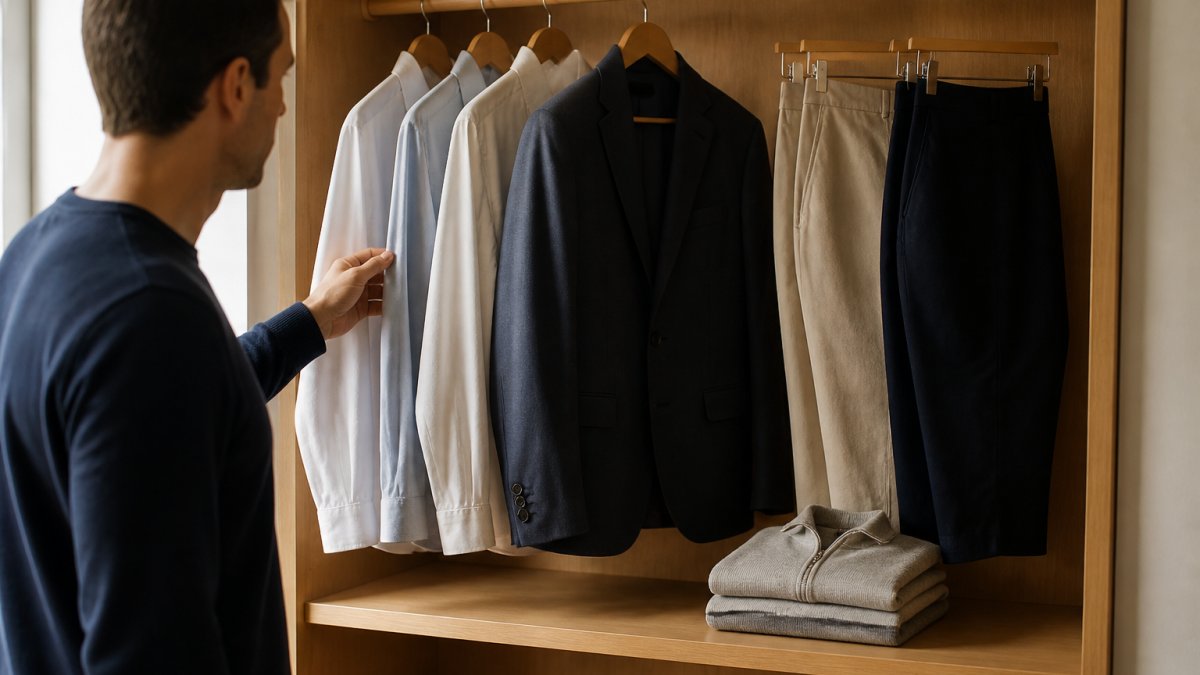
Tops, Bottoms, and Outerwear That Do the Most
Tops carry the most weight, so buy the best you can afford. Our S4S Men's box tee is 100% combed ring-spun cotton at 7 oz./yd.² with a ribbed, reinforced neckline, which is exactly the kind of top that survives regular wear. For layering, a half-zip does more than a plain sweatshirt: the S4S Unisex half-zip pullover is a 10 oz. heavyweight fleece with a relaxed fit and ribbed cuffs, so it works over a tee or under a coat.


How to Build a Minimalist Wardrobe for Men in 5 Steps
Learning how to build a minimalist wardrobe for men comes down to five steps: audit what you own, set a palette, fill gaps with versatile pieces, set a budget, and maintain what you keep. Do them in that order and you avoid the classic mistake of buying new things before you know what you already have.
- Pull everything out and sort into keep, fix, and cut.
- Choose two or three neutral colors as your palette.
- List the gaps, then buy only pieces that match at least three existing items.
- Set a per-item budget and stick to it.
- Schedule a repair and replacement check twice a year.
The Wardrobe Audit: What to Keep, Fix, or Cut
Keep a piece if it fits now, matches your palette, and you wore it in the last month. Fix it if the only problem is a hem, a button, or a loose seam. Cut it if it fits badly, needs a tailor to rescue, or duplicates something better. Be honest about the "someday" clothes. They are the reason your closet feels full and your options feel thin.
Men's Capsule Wardrobe Planning: Sizing It to Your Life
A men's capsule wardrobe is a fixed set of interchangeable pieces sized to your actual week, not to an imaginary one. The mistake most men make is building for a life they aspire to, the ski weekends, the black-tie dinners, the side hustle that never launches, instead of the life on their calendar. Size the capsule to the calendar and you stop buying clothes for a person you are not yet.
The 60/30/10 Sizing Rule
Before you buy a single piece, open your calendar for the last eight weeks and bucket every day into three contexts:
- Work and professional (target ~60% of your capsule): office days, client meetings, video calls, site visits.
- Everyday and off-duty (target ~30%): errands, school runs, weekends, casual social.
- Travel, events, and edge cases (target ~10%): flights, weddings, conferences, weather extremes.
If your real split is 70/20/10, build 70/20/10. A corporate professional with four office days a week needs two dark trousers and two clean layers before a fifth graphic tee ever earns a slot. A freelancer working from home needs comfortable everyday wear that still reads composed on a video call, a heavyweight tee and a structured half-zip do more for a Zoom grid than a blazer you never wear.
Three Capsule Templates by Context
Use these as starting counts, then adjust to your 60/30/10 split. Every template assumes a two- or three-tone neutral palette so pieces cross-match without thought.
The Office-Weighted Capsule (corporate, client-facing, or leadership role)
- 5 tops: 3 heavyweight tees or fine-gauge knits, 2 button-downs
- 3 bottoms: 2 dark trousers (one wool-blend, one cotton-twill), 1 chino in a mid-tone
- 2 layers: 1 structured half-zip or quarter-zip, 1 unstructured blazer
The Remote-and-Freelance Capsule (home office, flexible schedule)
- 6 tops: 4 heavyweight tees, 2 half-zips or sweatshirts
- 3 bottoms: 2 relaxed trousers, 1 dark denim
- 1 layer: 1 half-zip pullover that reads sharp on camera
The Travel-and-Field Capsule (frequent flyer, site work, or hybrid)
- 5 tops: 3 merino or heavyweight cotton tees, 2 layers
- 2 bottoms: 1 dark trouser, 1 technical or stretch chino
- 2 layers: 1 packable mid-layer, 1 weatherproof shell
Seasonal and Climate Modules
A capsule is not a year-round fixed set; it is a core plus modules. Keep the core (tops, bottoms, shoes) constant and swap the layer module by season:
- Warm months: add 1 lightweight overshirt and 1 breathable short-sleeve; drop the heavy fleece.
- Cold months: add 1 heavyweight fleece or quarter-zip and 1 insulated outer layer; keep one base layer for travel.
- Travel module: the heaviest layer goes on the plane, two tops match everything, and one pair of shoes does double duty. Pack the module, not the closet.
The Two-Week Test
Before you commit to a capsule size, run a two-week test: wear only the pieces in your proposed capsule for fourteen days and log what you reach for. If you reach outside the capsule more than twice, the capsule is missing a context, add one piece to cover it, not five. If you never reach for a piece, cut it.
Fit, Fabric, and Cost Per Wear: Where the Money Goes
Cost per wear is the price of a garment divided by the number of times you wear it, and it is the only clothing math that matters. A $30 shirt worn twice costs $15 per wear; a $90 shirt worn weekly for two years costs under $1 per wear. The cheap shirt is the expensive one. Fit decides whether you wear it at all, so buy for your shoulders and chest and have the waist and sleeves adjusted.
The Cost-Per-Wear Formula and a Buying Hierarchy
Run the math before you buy:
Cost per wear = Price ÷ (Wears per month × Months of expected life)
A $120 heavyweight tee worn 12 times a month for 24 months works out to about $0.42 per wear. A $25 fast-fashion tee worn 4 times a month for 6 months works out to about $1.04 per wear, more than double, for a worse fit and a shorter life. The formula does not tell you to buy the most expensive thing; it tells you to buy the piece you will actually wear.
Use this buying hierarchy when budget is tight:
- Fit and tailoring first. A $40 tailor bill on a $60 trouser beats a $200 trouser that gaps at the waist. Buy for shoulders and chest, then have the waist, hem, and sleeves adjusted.
- Fabric second. Heavier cotton knits (7 oz./yd.² and up) hold shape through repeated washing; a brushed fleece interior stays soft longer than a raw one. Merino resists odor and packs small. Pay for the fabric that survives your routine.
- Construction third. Look for reinforced necklines, flatlock or double-needle seams, and bar-tacked stress points. These are the details that separate a two-year tee from a two-month one.
- Brand and logo last. A logo is a cost, not a feature, in a minimalist wardrobe.
Fit Checks You Can Do in the Fitting Room
Fit is not a size; it is a set of checkpoints. Run these before you buy:
- Shoulders: the seam sits at the edge of your shoulder bone, not past it.
- Chest: you can slide a flat hand under the fabric at the chest without the buttons or seams pulling.
- Sleeves: the cuff ends at the wrist bone; a half-inch of shirt cuff showing under a layer is intentional, not sloppy.
A tailor can fix hem, waist, sleeve length, and taper, usually for $15-$40 per alteration at a local shop. A tailor cannot fix shoulders, armholes, or a rise that is wrong. Buy the fixable fit and tailor it; walk away from the unfixable one.
Fabric Trade-Offs by Routine
- Heavyweight cotton (7-10 oz./yd.²): holds shape, reads sharp under a layer, survives frequent washing. Best for tees and sweatshirts you wear weekly.
- Merino wool: odor-resistant, temperature-regulating, packs small. Best for travel and layering; costs more upfront but earns it back in wears.
- Cotton-twill and wool-blend trousers: hold a crease and resist wrinkling through a full workday. Best for office-weighted capsules.
The Budget Split
A common pattern among men who build a durable capsule is to weight spending toward the pieces you wear most: roughly half the budget on tops and shoes (the highest-frequency, highest-friction items), a third on bottoms and layers, and the remainder on outerwear and accessories. Set a per-item ceiling before you shop and a total seasonal budget, and treat the ceiling as a hard stop.
Minimalist Men's Outfit Ideas for Work, Travel, and Off-Days
Minimalist men's outfit ideas follow one rule: build from the same core and change the layer. For work, pair a neutral tee under a structured half-zip with your darkest trousers. For travel, wear the heaviest layer on the plane and pack two tops that match everything. For off-days, a boxy tee and relaxed trousers with clean shoes is a complete outfit, no styling required.
Timeless Pieces vs. Trend-Driven Buys
Timeless pieces earn their keep across seasons and settings; trend-driven buys are dated before they are worn out. The test is simple: can you name three outfits you would wear this piece in, right now, without buying anything else? If not, it is a trend purchase. A plain heavyweight tee, a dark half-zip, and a well-cut trouser pass that test every year.
Conclusion
The hard part of a minimalist wardrobe is not the shopping, it is the discipline to stop buying noise. Start4rmStart exists for men who treat their appearance the way they treat their goals: deliberate, resilient, and built to last. Our heavyweight S4S Men's box tee and S4S Unisex half-zip pullover are made to be worn hard and worn often, so your core pieces work as hard as you do.
Frequently Asked Questions
What is the 3-3-3 rule for men's fashion?
The 3-3-3 rule is a shortcut for building outfits: three colors, three textures, and three layers. It keeps a look visually interesting without adding clutter. For a minimalist style, pick a neutral palette of three colors (say navy, gray, and white), mix three textures (cotton, wool, leather), and cap the layers at three. The rule works because it forces coordination before you buy, so every piece you own can slot into dozens of complete outfits.
How do you build a minimalist wardrobe for men?
Start with an audit: pull everything out, keep what fits and gets worn, and set aside the rest. Then define a color palette of two or three neutrals, list the gaps, and buy only those pieces. Aim for around 30 to 40 items including shoes. Choose versatile pieces that work across work, weekends, and travel. Add one or two statement items at most, and replace rather than accumulate as things wear out.
What are the essential pieces in a minimalist men's wardrobe?
A workable core includes two or three plain tees, a half-zip or crewneck layer. That set covers most professional and social situations, and each item mixes with the others.
How many clothes should a man have in a minimalist wardrobe?
Most men do well with 30 to 40 items total, shoes included. That usually means around 8 to 10 tops, 4 to 5 bottoms, 3 to 4 layers, 2 pairs of shoes, and a small set of accessories. The exact number matters less than the coverage: every piece should pair with at least three others. If you work in a formal office, shift the count toward shirts and trousers; if you work from home, shift it toward tees and knitwear.
What colors work best for a minimalist wardrobe?
Stick to neutrals with one accent. Navy, charcoal, gray, white, black, olive, and tan cover nearly every combination and stay easy to match. Pick one accent color you actually like, such as burgundy or forest green, and use it in a single piece like a sweater. Neutral colors also hide wear better and stay in style longer, which lowers your cost per wear over time.
How can you make a minimalist outfit look more interesting?
Use texture, fit, and one focal point. A plain outfit in cotton, wool, and leather reads richer than a busy print. Get the fit right: shoulders on the seam, trousers breaking once at the shoe. Then add one detail, such as a textured knit, a clean watch, or a well-chosen tee with a subtle graphic. That single element does the work that five accessories would in a cluttered wardrobe.
Build your core around pieces that hold up, and let the rest go. Browse the full Start4rmStart collection and start with one layer you will wear every week.